
Compression, Extension and Torsion Springs: What Is the Difference?
The correct spring type depends on how force is applied, how the component moves and how much installation space is available inside the final assembly.
What Is a Compression Spring?
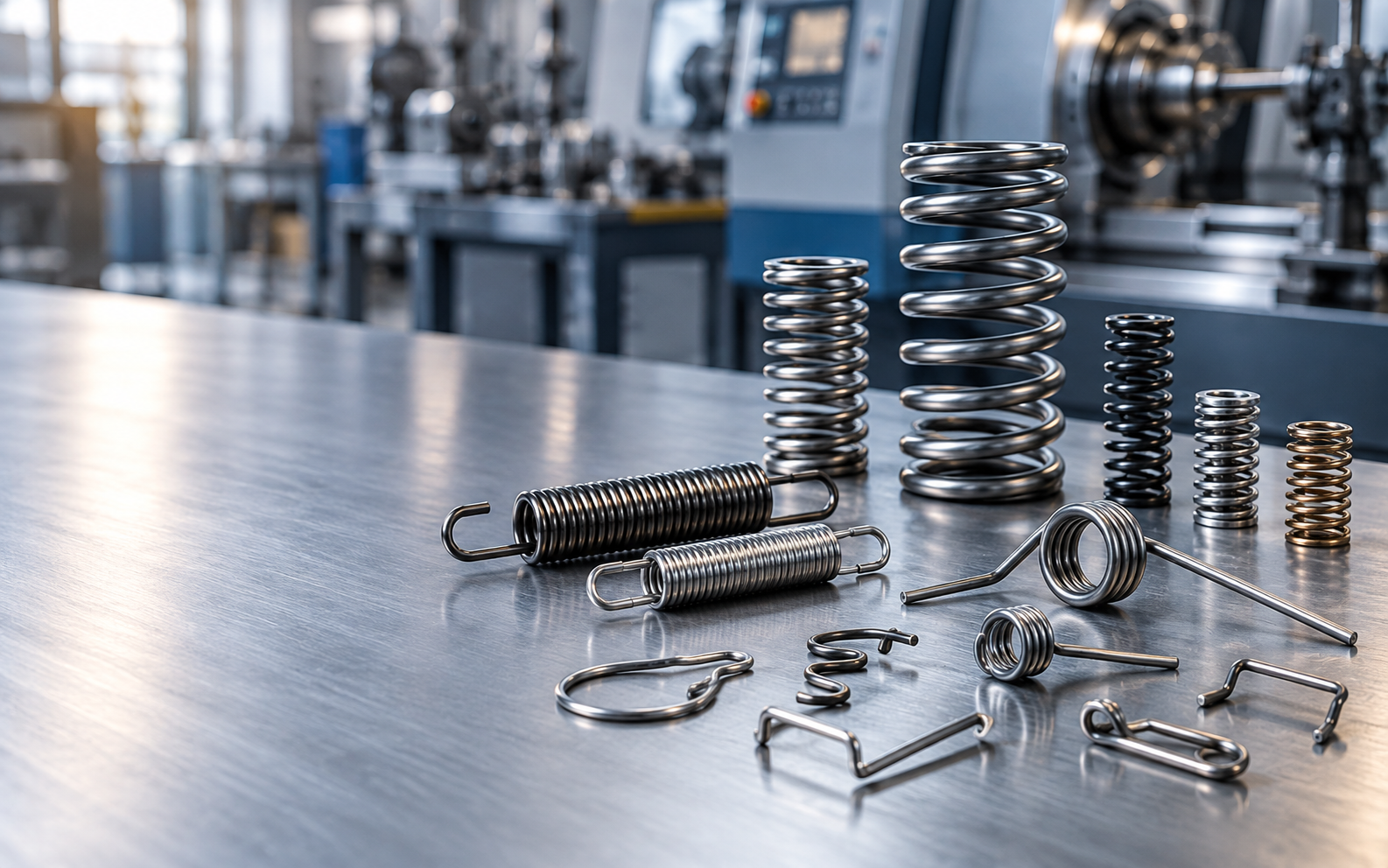
A compression spring is designed to resist compressive force. When a load pushes the spring shorter, the coils store mechanical energy. When the load is removed, the spring attempts to return to its original length.
Compression springs are commonly used in switches, valves, electronics, mechanical assemblies, industrial equipment and precision mechanisms.
Important parameters include wire diameter, outside diameter, free length, number of active coils, pitch, material and end configuration.
Compression Spring Design Considerations
The spring must fit inside the available installation space while producing the required force throughout its working range.
Designers should consider free length, compressed length, operating travel and solid height.
If the spring is compressed too far, the coils may approach full contact, which can affect both performance and service life.
What Is an Extension Spring?
An extension spring resists pulling force.
The coils are generally wound closely together, and the spring extends when tensile force is applied.
Hooks, loops or other end features connect the spring to surrounding components.
Extension springs are commonly used in return mechanisms, doors, levers, equipment covers and mechanical assemblies.
Initial Tension in Extension Springs
Many extension springs include initial tension—the force that keeps the coils tightly together before the spring begins to extend.
Initial tension affects how the spring responds when load is first applied.
Hook or loop geometry is also important because spring ends can experience high localized stress during operation.
What Is a Torsion Spring?
A torsion spring operates through rotational force.
Instead of moving primarily in a straight line, the spring stores energy when its ends rotate around the coil body.
Torsion springs are commonly used in hinges, clips, covers and mechanisms requiring rotational return force.
Torsion Spring Parameters
Important parameters include wire diameter, coil diameter, number of coils, leg angle, leg length, winding direction and required torque.
Clockwise and counterclockwise winding orientation can be important depending on the direction of loading.
The relationship between spring geometry and available installation space should therefore be reviewed carefully.
How to Choose the Correct Spring Type
The easiest starting point is the direction of force.
- If the spring is pushed together, use a compression spring.
- If the spring is pulled apart, use an extension spring.
- If the spring operates through angular movement, use a torsion spring.
Final selection should also consider load, travel, available space, service life and environmental conditions.
Material Selection
Spring material influences strength, corrosion resistance, fatigue performance and cost.
Common materials include stainless steel wire, carbon steel wire and various alloy wires.
Stainless steel is frequently selected when corrosion resistance is important, while other alloys may be used where higher strength or specific mechanical properties are required.
Why Custom Springs Are Often Necessary
Standard springs are suitable for many applications, but precision assemblies often have limited installation space or highly specific force requirements.
Custom springs can be designed around the product instead of forcing the product design around an existing spring.
Custom parameters may include coil diameter, wire diameter, length, pitch, force, torque, hook shape and leg configuration.
Prototype verification is recommended before larger production quantities are released.
Developing a Custom Precision Spring?
Send us your dimensions, material, load requirements and application information for evaluation.