
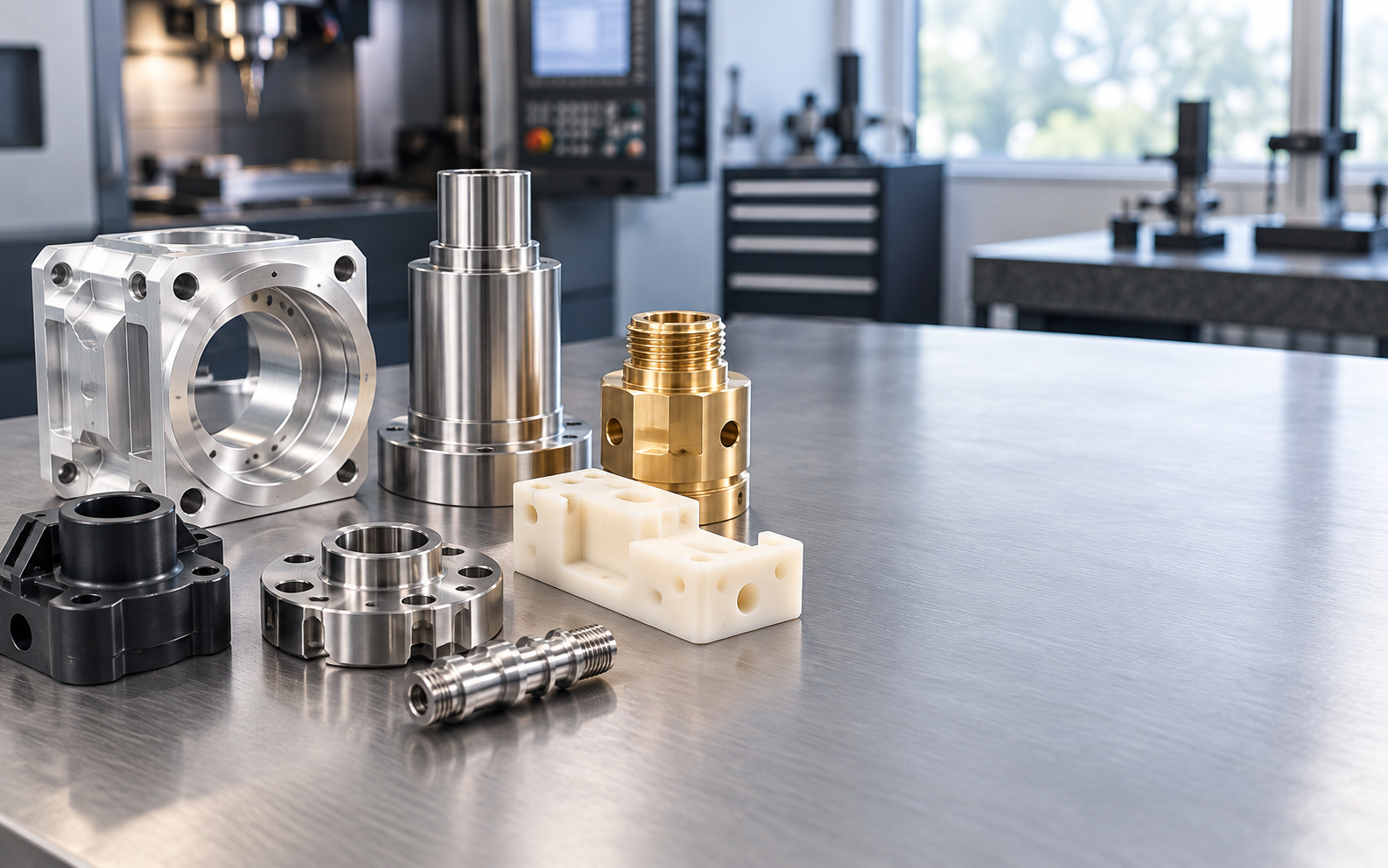
CNC Machining vs Swiss Machining: Which Is Better for Small Precision Parts?
Both processes can manufacture precision components, but their advantages differ depending on part geometry, diameter, tolerance, production quantity and machining complexity.
What Is Conventional CNC Machining?
CNC machining refers broadly to computer-controlled milling and turning processes.
CNC milling is commonly used for components with pockets, holes, flat surfaces and complex three-dimensional geometry, while CNC turning is typically used for cylindrical components such as shafts, sleeves, connectors and precision pins.
Modern CNC equipment can manufacture highly precise components in a wide range of metals and engineering plastics.
What Is Swiss Machining?
Swiss machining is a specialized turning process developed for producing small, highly precise components.
Unlike conventional turning, where the workpiece is held farther from the cutting point, Swiss machining supports the material close to the tool using a guide bushing.
This arrangement reduces deflection and makes Swiss machining particularly effective for small-diameter and slender components.
Why Swiss Machining Works Well for Small Parts
Small components can become difficult to machine when their length-to-diameter ratio increases.
A slender component may bend or vibrate under cutting forces. Because Swiss machining supports the material close to the cutting zone, it can provide greater stability for these geometries.
Typical applications include miniature shafts, precision pins, screws, bushings, watch components, medical parts and electronic components.
Geometry Is an Important Factor
Conventional CNC machining provides excellent flexibility for components with complex milled geometry.
Machining centers are particularly useful for housings, manifolds, plates and components requiring multiple pockets or three-dimensional surfaces.
Swiss machining is especially suitable for components that are primarily cylindrical but also require features such as cross holes, flats, slots or threads.
Part Size
Part size strongly influences process selection.
Swiss machining is generally associated with smaller-diameter bar components, while conventional CNC turning can accommodate larger diameters and heavier components.
For miniature components, Swiss machining may provide improved support and process stability.
Production Quantity
For prototypes or projects with frequent design changes, conventional CNC machining may provide greater flexibility.
Swiss machining becomes particularly attractive for repeated production of small precision parts.
Once programming and tooling are optimized, multiple operations can often be completed during a single cycle, reducing secondary handling.
Tolerance Requirements
Both CNC and Swiss machining can produce precision components.
Actual capability depends on material, geometry, tooling, equipment, fixture design and measurement methods.
Swiss machining can provide an advantage for small slender parts because the guide bushing helps reduce workpiece movement during machining.
Surface Finish
Components used in watches, medical assemblies and precision mechanisms may require smooth functional surfaces.
Tool selection, machine condition, cutting parameters and material properties all influence final surface quality.
Additional finishing operations may be used when the machined surface alone cannot meet the required appearance or functionality.
Which Process Should You Choose?
Swiss machining is worth considering when a component is small, cylindrical, slender or contains several features that can be completed from bar stock.
Conventional CNC machining may be more appropriate for larger components, complex housings, manifolds and parts requiring extensive milling.
There is no single process that is always better. The correct choice depends on geometry, tolerance, material, volume and manufacturing requirements.
Need Help Selecting a Machining Process?
Send us your drawing or technical requirements so we can evaluate a suitable manufacturing route.